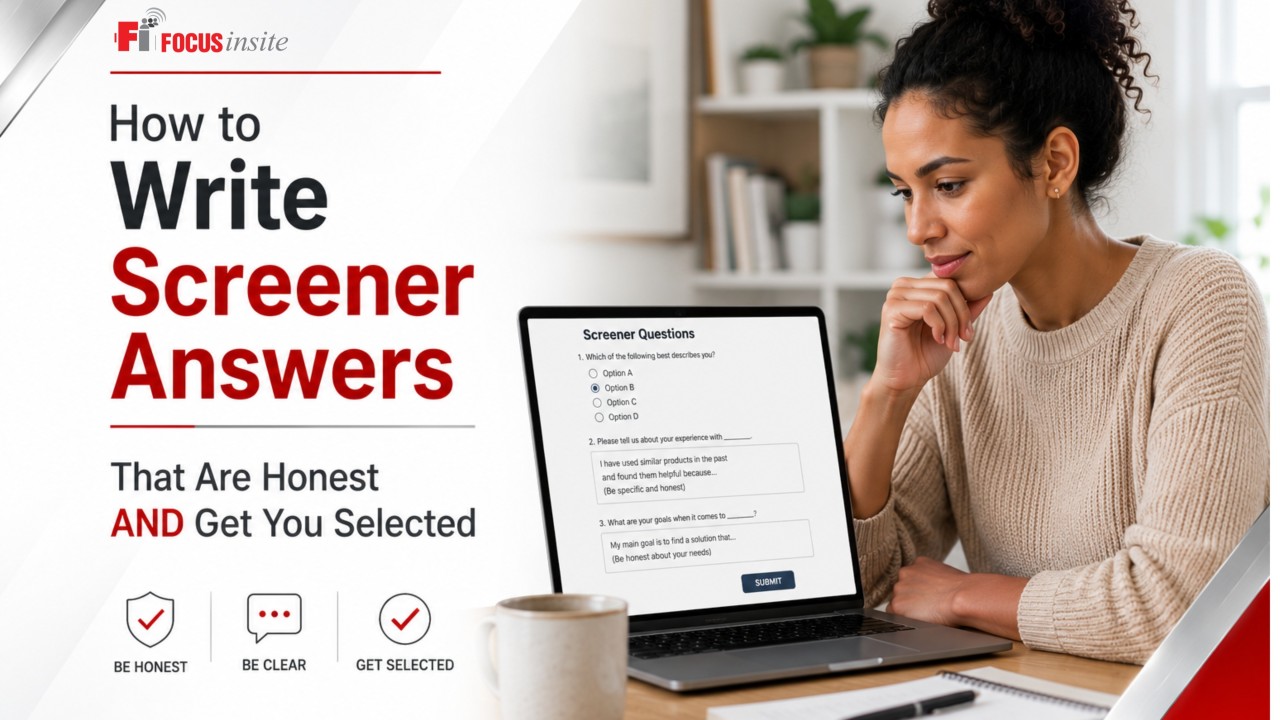
Most panelists who don’t get picked aren’t lying.
They’re just under-explaining.
The screener doesn’t reward whoever fits the demographic, it rewards whoever shows the recruiter they’re a real, articulate, specific person who’ll show up and contribute.
That’s an important distinction.
Many active panelists apply for study after study and wonder why they keep getting screened out. They assume they don’t fit the target audience, but often the issue isn’t who they are, it’s how they’re answering the questions.
The good news? You don’t need to exaggerate, guess, or tell recruiters what you think they want to hear.
You simply need to communicate your real experiences clearly.
Here’s how.
The Number One Reason Honest Panelists Get Filtered Out
One of the biggest mistakes panelists make is giving generic free-text answers.
Imagine a screener asks:
“Tell us about your experience purchasing health insurance.”
Many people write:
“I buy my own insurance and compare plans every year.”
That’s true, but it doesn’t tell the recruiter much.
A stronger answer might be:
“I purchase my family’s health insurance through the marketplace each year. I typically compare premiums, deductibles, and provider networks before choosing a plan. Last year I switched providers because my preferred doctor was no longer in-network.”
Neither answer is dishonest.
But one provides context, detail, and evidence of real-world experience.
Recruiters are looking for people who can contribute meaningful insights during a study. Generic responses often make it difficult to assess whether someone is truly a good fit.
Screener Honesty Isn't a Trick Question
Some panelists believe they need to “game the system” to qualify.
In reality, that approach usually backfires.
Researchers frequently use consistency checks throughout screeners. They compare your answers across multiple questions and sometimes against information already stored in your panel profile.
If your answers conflict, your application may be flagged automatically.
Even if you qualify once using exaggerated information, inconsistent responses can reduce your chances of being selected for future studies.
The most successful panelists have a simple strategy:
They answer honestly every time.
Recruiters aren’t searching for perfect participants.
They’re searching for authentic participants.
Specificity Beats Length Every Time
Many people assume a longer answer is a better answer.
Not necessarily.
A focused 30-word response is often more valuable than a vague 200-word response.
Consider these examples:
Weak Answer:
“I shop online a lot and buy many different products.”
Strong Answer:
“I place online orders two to three times per week, primarily through Amazon, Target, and Walmart. Most purchases include household items, electronics, and personal care products.”
The second answer gives the recruiter actual information they can use.
Specificity demonstrates that your experience is genuine.
The goal isn’t to write an essay.
The goal is to provide enough detail to paint an accurate picture.
How to Answer Behavioral Frequency Questions
Many screeners ask questions about how often you perform certain activities.
For example:
- How often do you purchase gasoline?
- How frequently do you shop online?
- How often do you visit a healthcare provider?
- How frequently do you use AI tools?
Researchers care less about the exact number and more about consistency and behavior patterns.
If you purchase gasoline twice a week, say so.
If you shop online monthly, say that.
Avoid guessing or selecting the option that seems most desirable.
When researchers ask about frequency, they’re trying to understand your real habits not test your ability to qualify.
Free-Text Boxes: What Researchers Are Actually Looking For
Whenever you encounter an open-ended question, recruiters are usually scanning for three things.
1. Evidence of Real Experience
Can you describe something you’ve actually done, purchased, used, or experienced?
Specific examples help prove authenticity.
2. Ability to Communicate
Focus groups and interviews rely on discussion.
Researchers want participants who can express their thoughts clearly.
You don’t need perfect grammar.
You simply need to explain your experiences in a way others can understand.
3. Engagement
Short answers aren’t always bad.
But answers that show thought and effort indicate you’ll likely be an engaged participant during the study itself.
When the Question Doesn't Quite Fit You
Sometimes you’ll encounter questions that don’t perfectly match your situation.
Maybe you purchase products for both personal and business use.
Maybe you occasionally use a service but not regularly.
Maybe none of the answer choices describe you exactly.
When this happens, choose the closest accurate answer not the answer that sounds most likely to qualify.
Trying to force yourself into a category often creates inconsistencies later in the screener.
Researchers understand that real life is messy.
Accuracy matters more than perfection.
Three Real Examples: Same Question, Different Answers
Let’s look at a common screener question:
“Tell us about your experience using artificial intelligence tools.”
Answer A: Rejected
“I use AI sometimes.”
Why it fails:
Too vague. The recruiter has no idea what tools are being used, how often they’re used, or for what purpose.
Answer B: Rejected
“I use every AI tool available every day for all my work and personal tasks.”
Why it fails:
Sounds exaggerated and unrealistic.
Answer C: Invited
“I use ChatGPT several times per week for research, writing assistance, and brainstorming ideas. I’ve also experimented with AI image generation tools for content creation projects.”
Why it works:
Specific, believable, and demonstrates relevant experience.
The key difference isn’t honesty.
It’s clarity.
A Quick Self-Check Before You Hit Submit
Before submitting any screener, ask yourself these five questions:
1. Are my answers accurate?
Avoid guessing or stretching the truth.
2. Are my answers consistent?
Make sure similar questions receive similar responses.
3. Did I provide specific examples?
Details help validate your experience.
4. Would a stranger understand my answer?
Clear communication matters.
5. Does this sound like a real person?
Because that’s exactly what recruiters want.
Final Thoughts
Getting selected for a paid study isn’t about finding the “right” answers.
It’s about providing real answers that help recruiters understand who you are and what experiences you bring to the conversation.
The most successful panelists aren’t necessarily the people who qualify for every study.
They’re the people who consistently provide clear, honest, and specific responses.
When recruiters trust your answers, they’re more likely to invite you to future opportunities.
So the next time you’re completing research screener answers, remember:
Don’t try to sound perfect.
Try to sound real.
That’s what gets selected.
Ready for More Opportunities?
Take a few minutes to review and update your panelist profile with these tips in mind.
Many recruiters draw from your profile before they ever send a screener. A complete, accurate profile can help match you with more relevant paid studies, focus groups, and interviews throughout the year.
Your next opportunity may already be looking for someone exactly like you.