
Consumer research forecasts trends by capturing early signals from real people their unmet needs, language shifts, and emerging frustrations then triangulating those signals across qualitative and quantitative methods to identify which patterns will scale. But here’s what most teams underestimate: the accuracy of any trend forecast depends almost entirely on whoyou recruit to talk to. The best methodology in the world can’t rescue a study built on the wrong participants.
Here’s how to forecast trends through consumer research and why your recruitment partner matters more than your discussion guide.
What Trend Forecasting Actually Requires
A useful trend forecast answers three questions:
-
- What is changing?— The specific behavior, attitude, or preference shifting
- Why is it changing?— The underlying drivers (cultural, technological, generational)
- How fast and how far?— The likely speed, scale, and durability of the shift
Without all three, you have an observation, not a forecast.
Why Consumer Research Beats Other Forecasting Methods
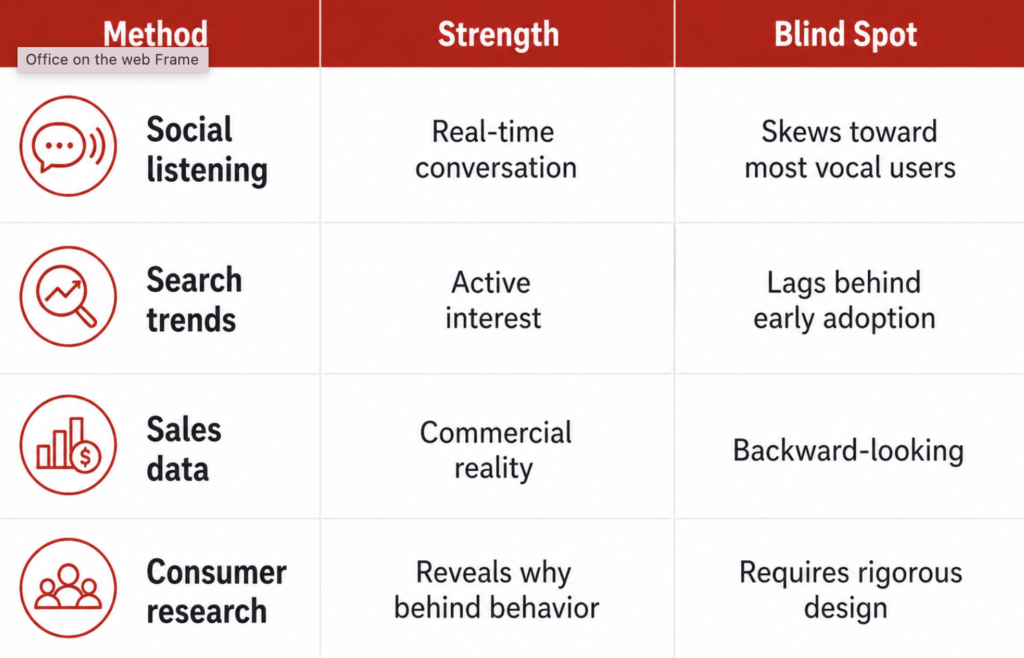
That last row is where most forecasts succeed or fail. A perfectly designed focus group with the wrong participants produces confident but wrong conclusions and confident wrong conclusions are more dangerous than no conclusions at all.
Why Recruitment Is the Hidden Engine of Trend Forecasting
Trend forecasting depends on hearing from people whose behavior today predicts the mainstream of tomorrow. That usually means recruiting:
- Early adopters in your category, not just current customers
- Lapsed users who left and can articulate why
- Category outsiders who reveal what the category looks like to non-believers
- Niche communities where new behaviors often start
- Generational cohorts that don’t always show up in standard panels
Most internal panels and DIY recruitment tools can’t reach these audiences. They oversample easy-to-find participants often current customers, often the same professional respondents who fill out every screener. The result is a forecast that confirms what you already do well, not what’s coming next.
A specialized recruitment partner solves this by sourcing participants beyond convenient databases, screening rigorously, and ensuring the people in your study actually represent the audiences your forecast depends on.
A 5-Step Framework for Trend Forecasting
- Sharpen the question. Replace “What’s next in beauty?” with “Which skincare ingredient claims will gain share among consumers aged 25–40 in the next 18 months?” Sharper questions produce actionable forecasts.
- Define who you need to hear from. Before choosing a method, list the audiences whose behavior predicts the trend you’re trying to forecast. This is the single biggest determinant of forecast quality.
- Combine qualitative and quantitative methods. Use focus groups or in-depth interviews to surface why, then use surveys or panels to validate how big.
- Listen for weak signals. Strong forecasts often start small: a phrase used by three participants across cities, a workaround consumers built for an unmet need, a frustration mentioned offhand.
- Triangulate before acting. A signal in one focus group is an anecdote. The same signal across multiple sources is a forecast.
Signals That Predict Real Trends
- Language shifts — new vocabulary or rejected jargon (precedes behavior change)
- Workarounds — DIY solutions for problems no product solves yet
- Tradeoff fatigue — frustration with compromises consumers used to accept
- Cross-category borrowing — expectations from one category bleeding into others
- Identity reframing — consumers describing themselves in new categories
These appear before sales data does. By the time a trend shows up in reports, the window for early action has often closed.
Common Forecasting Mistakes
- Recruiting only current customers (the #1 reason forecasts miss)
- Relying on professional respondents who pad screeners to qualify
- Confirming the brief instead of testing it
- Mistaking novelty for trend (not every emerging behavior scales)
- Treating one study as a forecast
Frequently Asked Questions
Why does recruitment matter so much for trend forecasting?
Because forecasts are only as accurate as the people they’re built on. A study with the wrong participants produces a confident answer to the wrong question. Specialized recruitment ensures you’re actually hearing from the audiences whose behavior predicts the trend.
How do you separate a real trend from a fad?
Three tests: durability (is the driver structural or temporary?), breadth (is it appearing across multiple segments?), and depth (does it change behavior or just generate conversation?).
How often should you refresh trend forecasts?
Annually for most categories, quarterly for fast-moving ones (beauty, technology, food and beverage), every 12–18 months for slower categories.
Can small brands use consumer research to forecast trends?
Yes and they often act on early signals faster than large competitors. The key is partnering with a recruiter who can deliver the right participants without enterprise-scale budgets.
Looking for a Panel Recruitment Partner? Focus Insite Can Help
If you’re planning a trend forecasting study, the most important decision you’ll make isn’t your methodology, it’s your recruitment partner.
Focus Insite specializes in recruiting hard-to-reach, high-quality participants for qualitative and quantitative research across consumer, B2B, healthcare, and specialty audiences. We go beyond convenience panels to source the early adopters, niche communities, and category outsiders that trend forecasting actually requires. Every participant is screened rigorously, vetted for authenticity, and matched to the specific audience your study needs.
Our clients work with us because:
- We recruit beyond standard databases— including hard-to-reach professionals, niche consumer segments, and specialty healthcare audiences
- We screen for authenticity, not just demographics— filtering out professional respondents who skew results
- We deliver across formats— focus groups, in-depth interviews, online communities, surveys, and panels
- We move fast— most projects launch within days, not weeks
- We protect participants and clients alike — with privacy practices documented in our Privacy Policy