
Most people who join a research panel think of themselves as passive participants, answer a few questions, collect a reward, move on. But the reality of how modern research works is far more interesting, and your role in it is far more consequential, than that transactional framing suggests.
Behind every product that feels like it was made for you, every policy that actually addresses what communities need, every service that solves the right problem, there is a chain of carefully collected human insight. And somewhere near the beginning of that chain, there is a panelist who took their participation seriously.
That could be you.
“Data is only as good as the people who provide it. When panelists show up with honesty and intention, researchers can build understanding that genuinely changes things.”
What researchers are actually trying to do
Understanding your role starts with understanding theirs. Researchers aren’t collecting answers for the sake of spreadsheets. They’re trying to solve a fundamental problem: the gap between what decision-makers assume about people and what people actually experience, believe, or need.
A product team might believe their app is intuitive. A healthcare provider might assume patients understand their instructions. A policymaker might think a certain group is unaffected by a new regulation. Survey data, your data is what tests those assumptions against reality. When the assumptions are wrong, good data catches it. When they’re right, good data confirms it with confidence.
Without diverse, honest, high-quality responses, researchers are essentially making decisions in the dark. They may notice a trend but not understand it. They may see a pattern but miss the nuance that explains it. Your response doesn’t just fill a data cell, it contributes texture, specificity, and lived reality to findings that would otherwise be thin.
The quality problem in research and how you're part of the solution
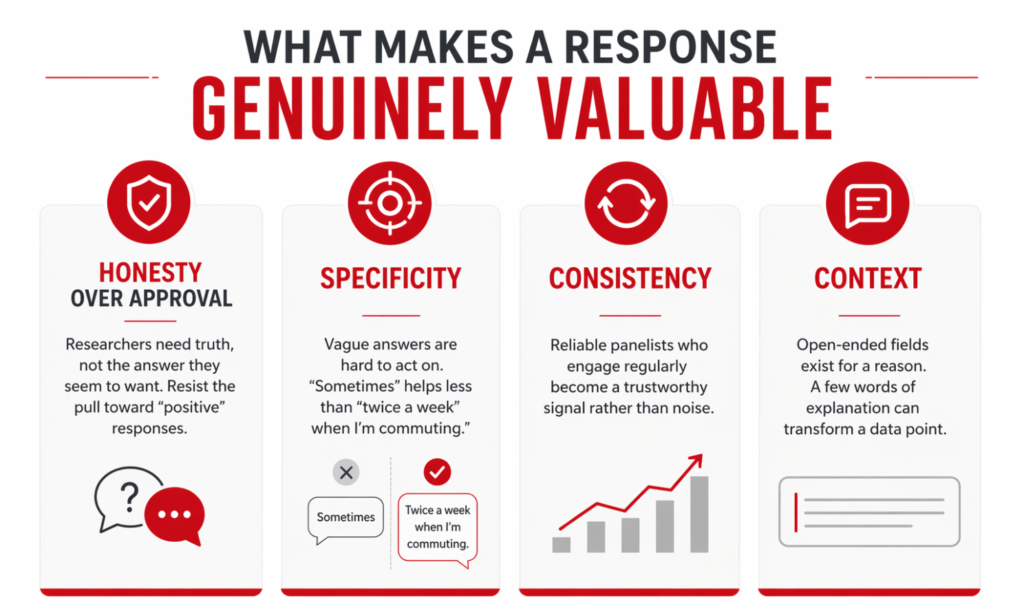
Research quality is one of the industry’s most persistent challenges. Inattentive responses, pattern-clicking, speeding through surveys, and providing socially desirable answers rather than truthful one, these behaviors quietly corrupt datasets that companies and institutions spend enormous resources collecting and acting upon.
The consequences ripple outward. A product gets built for a persona that doesn’t really exist. A messaging campaign misses because it was optimized for answers people thought researchers wanted to hear. A social program gets defunded because the survey that evaluated it didn’t capture the real experience of participants.
High-quality panelists are the antidote. When you engage thoughtfully, when you read questions carefully, reflect genuinely, and answer honestly even when the answer is uncomfortable or uncertain, you improve the signal-to-noise ratio of the entire dataset. You make it easier for researchers to find the real insight buried under the low-effort responses.
The shift: from respondent to contributor
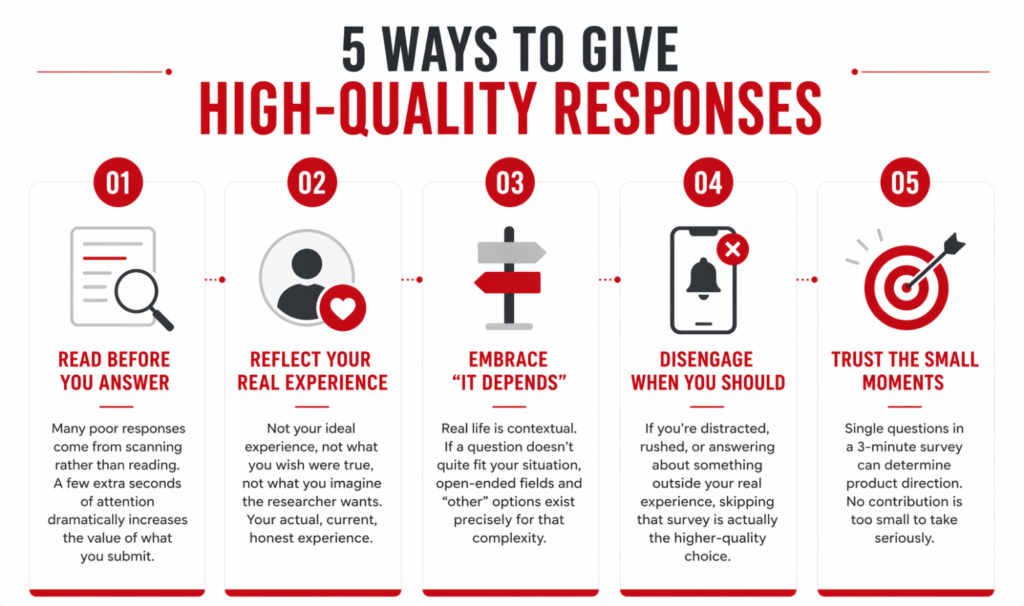
There’s a meaningful difference between someone who responds to research and someone who contributes to it. The respondent completes a transaction. The contributor participates in an act of knowledge-building.
That shift in identity changes how you engage. Contributors ask themselves: Am I representing my actual experience here? Is my answer precise enough to be useful? Am I giving this question the consideration it deserves? These aren’t onerous questions, they take seconds to ask but they produce fundamentally different (and better) responses.
Your perspective is genuinely irreplaceable
Here’s something worth sitting with: no algorithm, model, or synthetic data source can replicate what you know from having lived your specific life. Your demographic intersection, your geographic context, your personal history with a product category, your cultural frame of reference these produce a perspective that exists nowhere else in the dataset.
When researchers design diverse panels, they’re not just meeting inclusion benchmarks. They’re trying to ensure that the full range of human experience is represented in their findings because decisions made from narrow data tend to serve narrow populations. Your participation doesn’t just fill a quota. It ensures that the research reflects a world that actually includes people like you.
The brands, services, and systems that affect your daily life are being shaped by research happening right now. The question isn’t whether you want to influence those decisions, it’s whether your voice is in the room when they’re made.
“Being a panelist is one of the quietest forms of civic participation and one of the most consistent ways your opinion actually reaches the people building the world around you.”
Closing thought: quality is a choice you make every time
You can’t control what researchers do with your responses. You can’t guarantee that your honest input will translate into a better product or a wiser policy. But you can control the integrity of what you put in. And over time, panelists who consistently bring their full attention to research become something researchers genuinely rely on not just a statistic in a completion report, but a trustworthy voice that improves the quality of everything it touches.
That’s what it means to be an insight driver rather than just a panelist. It’s a choice available to you on every survey, every interview, every moment of engagement. And the research ecosystem and the world that benefits from it, is better when more people make it.
Found this useful? Share it with someone who participates in research.