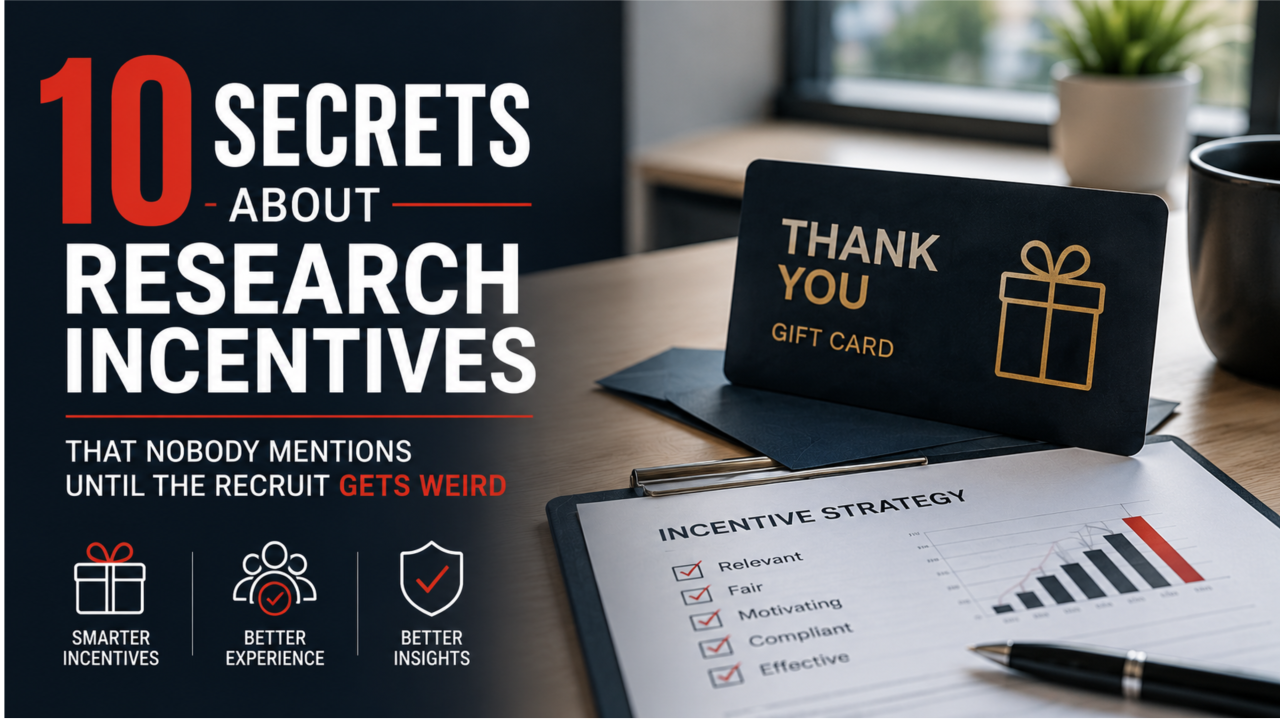
Incentives are like hot sauce. The right amount makes everything better. The wrong amount creates chaos and people start sweating.
For Fortune 1000 research, incentives are not just payments. They are part of recruitment strategy, quality control, show-rate protection, and participant respect.
So let’s get into the top 10 secrets, because the right humans change the whole decision.
1. The incentive should match the audience
A senior IT decision-maker, a rare patient, a consumer shopper, and a physician do not value time the same way. Incentive strategy starts with audience reality.
2. Too low can damage quality
If the incentive does not respect the respondent’s time, the right people may ignore the opportunity, leaving the recruit to whoever is easiest to reach.
3. Too high can attract the wrong crowd
A high incentive is sometimes necessary, but it can attract bad actors when screening is weak. More money requires more verification.
4. Visibility matters
How and where the incentive is promoted affects who responds. Lead with relevance and legitimacy, not just the payout.
5. Incentives affect show rates
Clear incentive expectations can improve attendance. Confusing incentive details can create friction and mistrust.
6. Complex audiences need thoughtful compensation
Patients, caregivers, physicians, executives, and technical experts may need incentives that reflect effort, sensitivity, and scarcity.
7. Payment timing should be clear
Participants should know when and how they will be paid. Unclear payment processes create avoidable anxiety.
8. The incentive does not replace the screener
Money may get attention. It does not prove qualification. Screening still has to do the work.
9. Track incentive performance
If a source produces volume but weak fits, the incentive strategy may be attracting the wrong respondents.
10. Use incentives to support trust
The best incentive strategy makes participants feel respected while helping the research team protect quality.
How To Use This On Your Next Study
Before the next recruit launches, bring this list into the kickoff conversation. Pick the two or three secrets that feel most exposed in the current study, then decide who owns them before fieldwork begins.
For example, if the audience is senior or technical, focus on verification and sourcing. If the timeline is tight, focus on show-rate protection and backup recruits. If the incentive is high, focus on screener strength and fraud risk.
This is how respondent quality becomes part of the research plan instead of something everyone worries about after the first bad interview.
The Big Takeaway
A smart incentive does more than fill a recruit. It helps attract the right humans and keep them committed through the study.
The old way was to fill seats. The stronger way is to build a defensible sample: real humans, real qualifications, real insight. When a study is high-stakes, the recruiting process has to protect the business decision behind the research.
Need real, qualified people for your next high-stakes market research study?
Focus Insite helps Fortune 1000 teams recruit verified respondents for qualitative research, B2B research, UX research, healthcare research, product research, customer research, and hard-to-reach audience studies.
Business: Focus Insite
Website: www.focusinsite.com
Book a discovery call: fortune1000.focusinsite.com