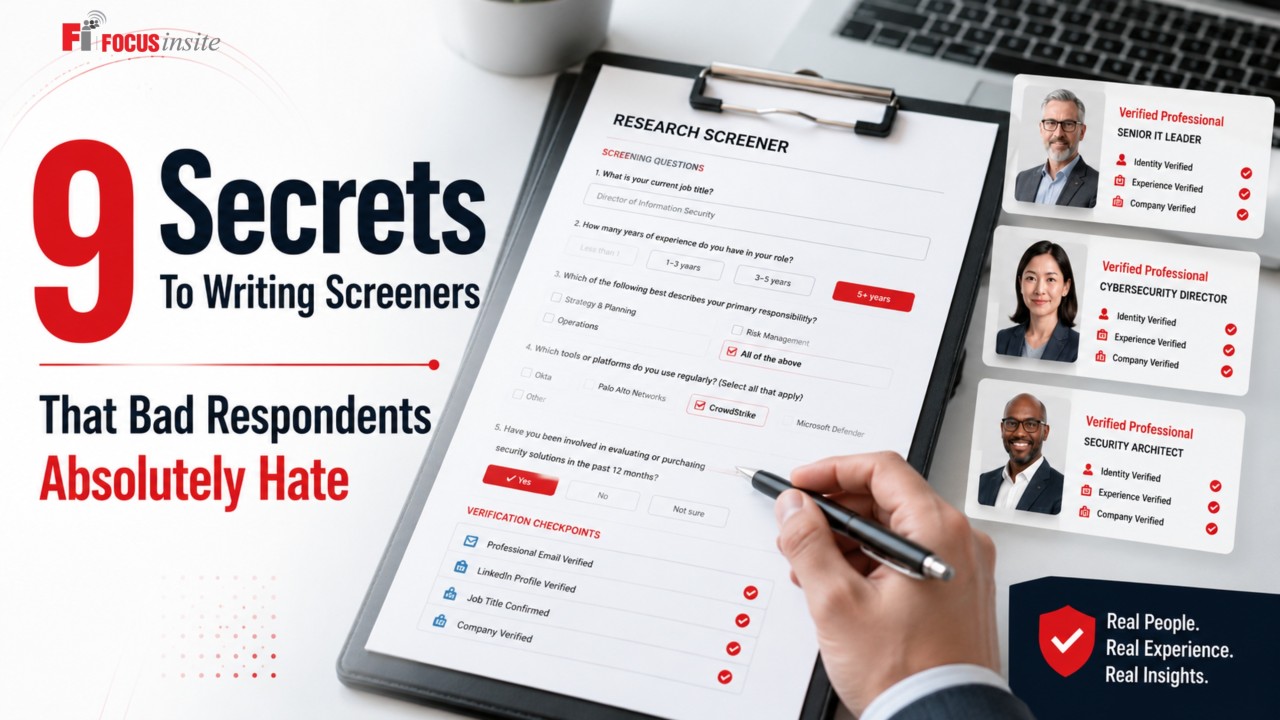
A screener is not just a form. It is the bouncer at the door of your research study. And if the bouncer is asleep, everyone gets in.
Strong screeners do not need to be long, painful, or weirdly invasive. They need to be smart. They should help real respondents qualify and make it harder for bad-fit respondents to bluff their way through.
So let’s get into the top 9 secrets, because the right humans change the whole decision.
1. Ask about actions, not identities
“Are you a decision-maker?” is easy. “Tell us about the last decision you influenced” is better. Actions prove relevance.
2. Include time anchors
Recent behavior matters. Ask when something happened, how often, or what changed in the last 30, 60, or 90 days.
3. Use plain language strategically
Jargon can attract pretenders who studied the topic. Plain-language questions reveal whether someone truly understands the experience.
4. Build consistency checks
Ask related questions in different ways. Real respondents stay directionally consistent. Fake respondents often wobble.
5. Avoid giving away the prize
If every question telegraphs the qualification path, you are coaching people into the study. Keep criteria clear internally, but do not make the right answers obvious.
6. Ask for examples
Examples are the enemy of fakers. They require detail, memory, and context.
7. Disqualify politely but firmly
Do not keep borderline respondents because the timeline is tight. Weak fits cost more later.
8. Review open-ends like evidence
Open-ended answers should not be decoration. They are clues. Look for specificity, texture, and real experience.
9. Test the screener before launch
Ask someone on the team to try to beat it. If they can easily guess their way in, fix it before fieldwork.
How To Use This On Your Next Study
Before the next recruit launches, bring this list into the kickoff conversation. Pick the two or three secrets that feel most exposed in the current study, then decide who owns them before fieldwork begins.
For example, if the audience is senior or technical, focus on verification and sourcing. If the timeline is tight, focus on show-rate protection and backup recruits. If the incentive is high, focus on screener strength and fraud risk.
This is how respondent quality becomes part of the research plan instead of something everyone worries about after the first bad interview.
The Big Takeaway
The best screener does not simply find people. It protects the conversation from people who should not be there.
The old way was to fill seats. The stronger way is to build a defensible sample: real humans, real qualifications, real insight. When a study is high-stakes, the recruiting process has to protect the business decision behind the research.
Call To Action
Need real, qualified people for your next high-stakes market research study?
Focus Insite helps Fortune 1000 teams recruit verified respondents for qualitative research, B2B research, UX research, healthcare research, product research, customer research, and hard-to-reach audience studies.
Email:
Website: www.focusinsite.com
Book a discovery call: fortune1000.focusinsite.com