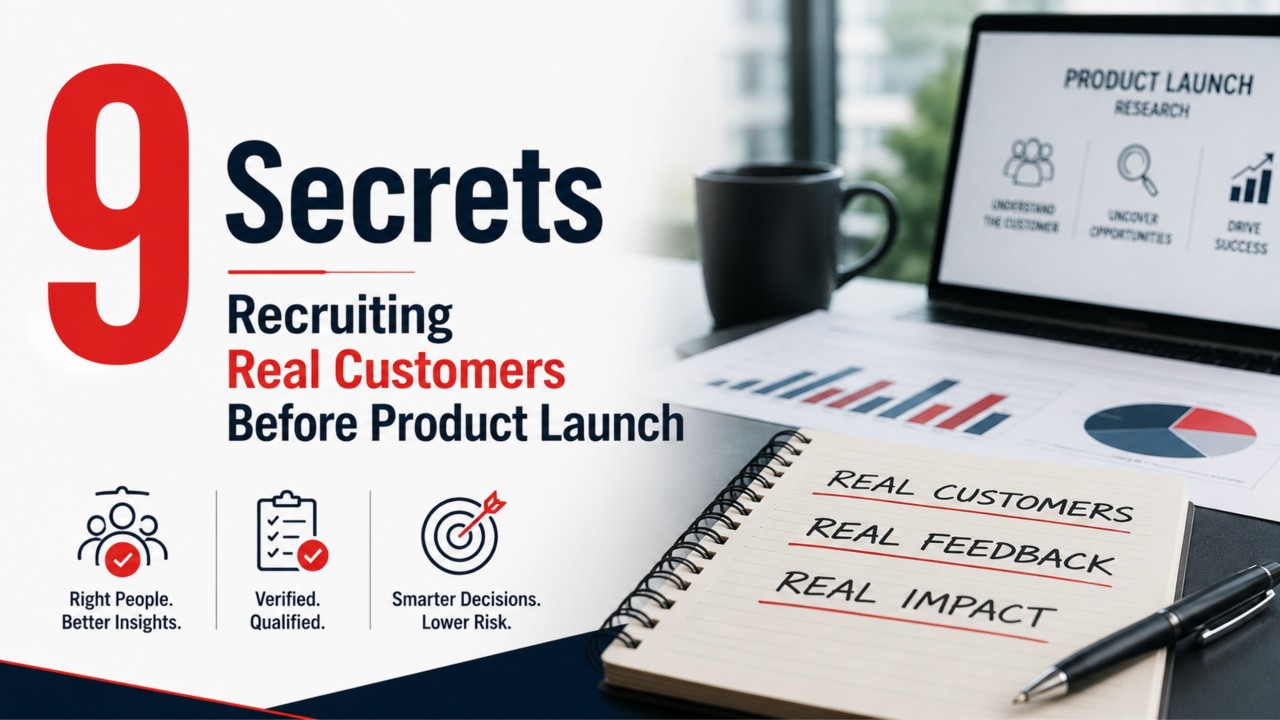
Product launches are basically business trust falls. The team has a roadmap, a deadline, a launch plan, and a room full of people hoping the research was right.
The worst time to discover weak sample is after the go-to-market machine is already moving. Real product launch research starts with real customers who match the decision at hand.
So let’s get into the top 9 secrets, because the right humans change the whole decision.
1. Recruit for the launch question
Testing messaging, pricing, packaging, adoption, and usability may require different customers. Start with the decision, then define the human.
2. Include buyers and users on purpose
A buyer may care about budget and risk. A user may care about workflow and frustration. Both can matter, but they should not be mixed accidentally.
3. Screen for category behavior
People who recently bought, evaluated, switched, ignored, or rejected the category may reveal launch-critical insight.
4. Find the almost-customer
The people who nearly bought but did not can be gold. They often know the friction better than your happiest fans.
5. Avoid over-recruiting enthusiasts
Fans are useful, but a launch needs market reality. Balance excitement with skepticism.
6. Validate the problem before the solution
A participant can like an idea without having the pain. Screen for problem intensity before asking about product appeal.
7. Watch for performative feedback
Some people want to sound innovative. Product teams need honest adoption signals, not applause.
8. Protect timing with backups
Launch research often has zero chill. Backup recruits protect the schedule when someone ghosts.
9. Create a sample story the launch team trusts
The final recommendation should include why these humans were the right ones to hear before the bet went live.
How To Use This On Your Next Study
Before the next recruit launches, bring this list into the kickoff conversation. Pick the two or three secrets that feel most exposed in the current study, then decide who owns them before fieldwork begins.
For example, if the audience is senior or technical, focus on verification and sourcing. If the timeline is tight, focus on show-rate protection and backup recruits. If the incentive is high, focus on screener strength and fraud risk.
This is how respondent quality becomes part of the research plan instead of something everyone worries about after the first bad interview.
The Big Takeaway
A product launch does not need random opinions. It needs the right humans telling the truth before the market does.
The old way was to fill seats. The stronger way is to build a defensible sample: real humans, real qualifications, real insight. When a study is high-stakes, the recruiting process has to protect the business decision behind the research.
Need real, qualified people for your next high-stakes market research study?
Focus Insite helps Fortune 1000 teams recruit verified respondents for qualitative research, B2B research, UX research, healthcare research, product research, customer research, and hard-to-reach audience studies.
Business: Focus Insite
Website: www.focusinsite.com
Book a discovery call: fortune1000.focusinsite.com