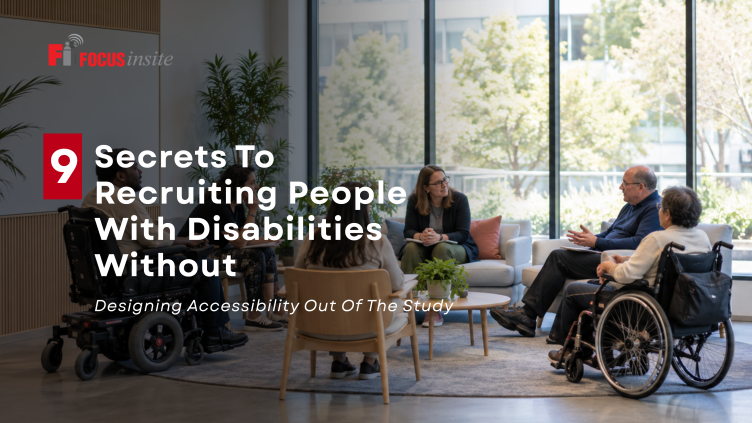
If accessible and inclusive qualitative recruitment were only about finding willing participants, it would be easy. The hard part is finding people whose experience maps cleanly to the decision the business is trying to make. That is the standard UX, healthcare, product, and customer insights teams researching people with disabilities should use before the first interview starts. That is why this article is intentionally different from the usual generic recruiting checklist. It focuses on the specific human realities inside this audience and what those realities mean for study design. The aim is simple: help research teams get closer to the people who can actually explain the behavior behind the business question.
So, in true listicle fashion, here are the 9 ideas that matter most for this specific kind of research. None of them require theater. They require a sharper definition of whose experience belongs in the room.
1. Ask about access needs before logistics are locked
Accessibility works best when it is planned, not improvised five minutes before a session. This is where real-world behavior beats neat assumptions. People do not experience products, services, or workflows in isolation; they experience them inside jobs, budgets, policies, habits, and interruptions. Strong accessible UX research should preserve that messiness rather than screen it away. When the participant can explain the tradeoffs, exceptions, and workarounds, the research team gets insight that can survive a serious stakeholder question later. A useful kickoff prompt is: what would this person have to have done recently for their answer to deserve weight in the decision?
2. Do not treat disability as one segment
Vision, hearing, mobility, cognitive, neurodivergent, and chronic-condition experiences can require different recruiting and session design. The useful move is to ask for a recent example. Recent examples reveal sequence, stakes, and ownership in a way that broad self-description cannot. They also make it easier to distinguish true experience from secondhand familiarity. For UX, healthcare, product, and customer insights teams researching people with disabilities, that turns disability research participants into a source of evidence rather than a collection of opinions. If a participant cannot describe the moment in concrete terms, the team should question whether that voice belongs in the study. A useful sourcing check is to list the channels where this exact kind of person naturally works, learns, buys, or asks peers for advice, then recruit from more than one of them.
3. Let participants choose the communication channel
Email, phone, text, captions, relay services, or another method may be easier depending on the person. Do not let convenience choose this for you. The easiest people to recruit are often the most visible, responsive, or enthusiastic, which can create a subtle sample bias. Good inclusive user research deliberately includes the people who are harder to reach when those people represent the real market. That may require different sourcing channels, more thoughtful outreach, or a wider scheduling window, but the payoff is a sample that better reflects the decision environment. A useful quality check is to ask whether a skeptical stakeholder could understand why this participant belonged in the study without seeing the entire screener.
4. Test the research platform for accessibility first
The participant should not discover that your tool blocks keyboard navigation, captions, screen readers, or assistive technology. Think of this as a credibility checkpoint. If the final readout depends on this distinction, the recruiting plan should be able to explain how it was protected. That does not mean building a bureaucratic maze. It means using one or two clear questions, evidence checks, or sourcing rules that make the sample logic visible. The stronger the accessibility research recruitment, the easier it is for stakeholders to trust what the interviews are telling them. A useful kickoff prompt is: what would this person have to have done recently for their answer to deserve weight in the decision?
5. Screen for product context, not just disability status
The study still needs the right user, customer, patient, employee, or buyer. Disability is only one part of relevance. This matters because accessible and inclusive qualitative recruitment is full of near-fit participants who sound relevant until the conversation gets specific. A strong recruiting plan turns the heading above into a qualification choice, not a nice-to-have. In practice, that means the team should document what evidence would make the participant credible and what evidence would make the same person a poor fit. The result is better people with disabilities research and fewer interviews that sound polished but do not move the decision forward. A useful sourcing check is to list the channels where this exact kind of person naturally works, learns, buys, or asks peers for advice, then recruit from more than one of them.
6. Build extra time without making people feel like a problem
Flexible pacing can improve insight quality. The goal is access, not special treatment theater. The trap is assuming the label tells you enough. In accessible and inclusive qualitative recruitment, labels hide variation in responsibility, recency, environment, and stakes. Ask what the person actually did, what changed because of their action, and what constraints they faced. Those details create stronger qualitative research recruitment because the respondent can speak from lived context instead of category familiarity. The best sample is not the one with the fanciest titles; it is the one that matches the business question. A useful quality check is to ask whether a skeptical stakeholder could understand why this participant belonged in the study without seeing the entire screener.
7. Respect privacy around accommodations
Ask only what the study needs to support participation. Do not turn access logistics into unnecessary medical interrogation. Treat this as a design decision, not a scheduling detail. If the sample misses this dimension, the moderator may spend valuable time discovering the mismatch live. That is expensive and avoidable. Build the distinction into sourcing, qualification, and quota planning so the study captures the contrast on purpose. For UX, healthcare, product, and customer insights teams researching people with disabilities, this is one of the simplest ways to make inclusive market research more actionable without making the project more complicated than it needs to be. A useful kickoff prompt is: what would this person have to have done recently for their answer to deserve weight in the decision?
8. Recruit beyond the easiest accessibility communities
Convenience sources can overrepresent highly engaged advocates. Broaden sourcing when the research needs a wider range of lived experience. This is where real-world behavior beats neat assumptions. People do not experience products, services, or workflows in isolation; they experience them inside jobs, budgets, policies, habits, and interruptions. Strong participant recruitment accessibility should preserve that messiness rather than screen it away. When the participant can explain the tradeoffs, exceptions, and workarounds, the research team gets insight that can survive a serious stakeholder question later. A useful sourcing check is to list the channels where this exact kind of person naturally works, learns, buys, or asks peers for advice, then recruit from more than one of them.
9. Include accessibility in the sample story
If accessibility shaped how people participated, document it as part of methodology instead of treating it as invisible logistics. The useful move is to ask for a recent example. Recent examples reveal sequence, stakes, and ownership in a way that broad self-description cannot. They also make it easier to distinguish true experience from secondhand familiarity. For UX, healthcare, product, and customer insights teams researching people with disabilities, that turns UX research accessibility into a source of evidence rather than a collection of opinions. If a participant cannot describe the moment in concrete terms, the team should question whether that voice belongs in the study. A useful quality check is to ask whether a skeptical stakeholder could understand why this participant belonged in the study without seeing the entire screener.
The Big Takeaway
The big lesson is not that recruiting has to become harder. It is that accessible and inclusive qualitative recruitment deserves a sample designed around the actual decision. When teams define the human context clearly, the interviews get sharper, the patterns become easier to interpret, and the final recommendation is easier to defend. Before fieldwork starts, pressure-test the participant definition against the decision the research is supposed to support. If those two things are not tightly connected, fix the sample plan before the first interview rather than explaining the gap after the readout. For teams searching for better inclusive market research, participant recruitment accessibility, UX research accessibility, or accessible qualitative research, the same principle applies: specificity beats convenience when the decision is high-stakes.
Need real, qualified people for your next high-stakes qualitative research study? Focus Insite recruits hard-to-reach professionals, customers, operators, decision-makers, and specialized audiences nationwide.
Website: www.focusinsite.com
Pressure-test your screener before your next study: assessment.focusinsite.com