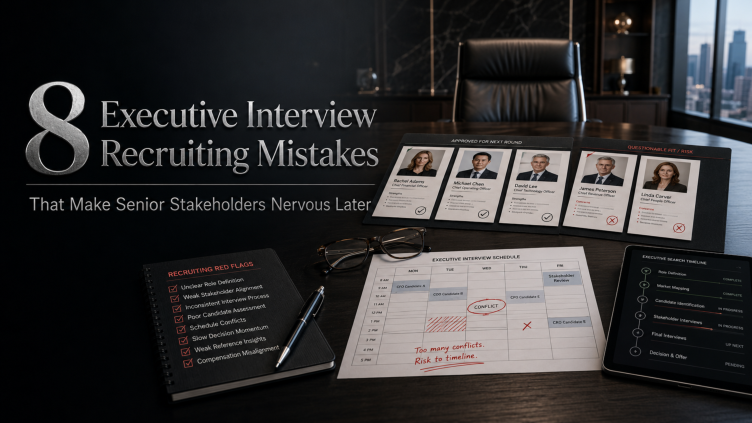
Executive interviews sound glamorous until you have to recruit real executives who are busy, skeptical, and not exactly refreshing their inbox hoping for a research invite. The stakes are high because one weak executive interview can waste an expensive session and raise awkward stakeholder questions.
Here is the not-so-glamorous truth: most research problems do not explode all at once. They creep in through tiny assumptions. The audience is a little too broad. The screener is a little too easy. The incentive is a little too tempting. The timeline is a little too tight. Then suddenly a multimillion-dollar decision is leaning on interviews that feel thinner than they should.
So, in true listicle fashion, let us unpack the top 8 mistakes to watch before your next study goes live. No panic. No finger-pointing. Just the stuff smart teams fix before the project gets messy.
One more thing before we get into the list: this is not about making research teams paranoid. It is about giving them language for the risk they already feel. Verification Vanessa, the Fortune 1000 insights leader, is not trying to make recruiting harder. She is trying to make the decision safer. She needs research participant screening, respondent verification, show-rate planning, and qualitative research recruitment to work together so the final insight can survive tough questions from product, marketing, UX, healthcare, finance, and leadership.
1. Mistaking Seniority for Relevance
An executive can be impressive and still wrong for the study.
Relevance beats status.
This does not require a giant process. It requires one stronger checkpoint: ask what could go wrong if this person is not who they claim to be, then build the qualification step around that risk.
2. Failing to Verify Decision Involvement
Did they evaluate the solution? Approve budget? Influence the shortlist? Own the pain?
The decision role matters.
This does not require a giant process. It requires one stronger checkpoint: ask what could go wrong if this person is not who they claim to be, then build the qualification step around that risk.
3. Using Generic Outreach
Senior people can smell mass outreach instantly.
Credible, specific communication improves participation.
This does not require a giant process. It requires one stronger checkpoint: ask what could go wrong if this person is not who they claim to be, then build the qualification step around that risk.
4. Underestimating Scheduling Friction
Executives reschedule. Often.
Recruiting plans need flexibility and backup options.
This does not require a giant process. It requires one stronger checkpoint: ask what could go wrong if this person is not who they claim to be, then build the qualification step around that risk.
5. Offering an Incentive That Does Not Match the Ask
Time-starved professionals need respectful compensation or a compelling reason to participate.
The value exchange has to feel appropriate.
This does not require a giant process. It requires one stronger checkpoint: ask what could go wrong if this person is not who they claim to be, then build the qualification step around that risk.
6. Not Preparing for Gatekeepers
Assistants, procurement teams, compliance policies, and corporate calendars can all affect access.
Executive recruitment is a process, not a wish.
This does not require a giant process. It requires one stronger checkpoint: ask what could go wrong if this person is not who they claim to be, then build the qualification step around that risk.
7. Skipping Pre-Call Confirmation
The right person on paper may still be the wrong person live.
Confirmation is also a quality checkpoint.
This does not require a giant process. It requires one stronger checkpoint: ask what could go wrong if this person is not who they claim to be, then build the qualification step around that risk.
8. Failing to Brief Stakeholders on Sample Tradeoffs
Executive recruiting often involves real constraints.
Clear tradeoff communication prevents surprise later.
This does not require a giant process. It requires one stronger checkpoint: ask what could go wrong if this person is not who they claim to be, then build the qualification step around that risk.
For executive interview recruiting, the difference between ordinary recruiting and strong recruiting is usually not one dramatic move. It is a stack of small, disciplined choices: define the audience clearly, source where the real people actually are, screen for lived experience, confirm attendance, watch for fraud signals, and communicate risk early. That is not overkill. That is how serious research earns trust.
A useful team exercise is to take your next recruit and ask three plain-English questions before anyone writes a screener: Who must this person really be? What would make them the wrong person even if they technically qualify? And how will we prove the difference before they get into the session? Those questions sound simple, but they reveal where most respondent quality risk is hiding.
This is also where procurement, ResearchOps, moderators, product leaders, and insights teams need to be aligned. If one group is optimizing for speed, another is optimizing for cost, and another is depending on the findings to make a major decision, the recruiting plan has to balance all three. Cheap sample that creates rework is not cheap. Fast recruiting that produces weak interviews is not fast. A full schedule that falls apart on interview day is not a win.
Pressure-Test Your Screener Before You Launch
Before your next executive interview study goes live, pressure-test your screener by asking:
- Could someone who looks senior on paper still be the wrong person for this study?
- Are we verifying actual decision involvement, not just job title?
- Could an unqualified respondent figure out the “right” answers and pass?
- What evidence would prove that this person has the experience we need?
A strong screener should not simply confirm that someone is an executive. It should help prove that they are the right executive for the research question.
Want to see where your screener may have gaps? Pressure-test it with Focus Insite’s free Screener Assessment Tool: assessment.focusinsite.com
The big takeaway is simple: the quality of the insight cannot outrun the quality of the humans behind it. Better research is not only about better questions or better analysis. It starts earlier, with better recruiting decisions, clearer qualification, stronger respondent verification, and a partner who understands when a recruit needs more than generic sample.
For Fortune 1000 teams, this is where the conversation gets very practical. If the study supports a product roadmap, healthcare decision, AI validation, cybersecurity strategy, customer experience initiative, or go-to-market move, the sample needs to be more than full. It needs to be credible. It needs to be explainable. It needs to be defensible when leadership asks the obvious question: “How do we know these were the right people?”
Need real, qualified people for your next high-stakes qualitative research study? Focus Insite recruits and verifies participants across B2B, healthcare, patients, caregivers, executives, professionals, consumers, and hard-to-reach audiences.
Email [email protected], or visit www.focusinsite.com. To learn more or book a discovery call, visit fortune1000.focusinsite.com.