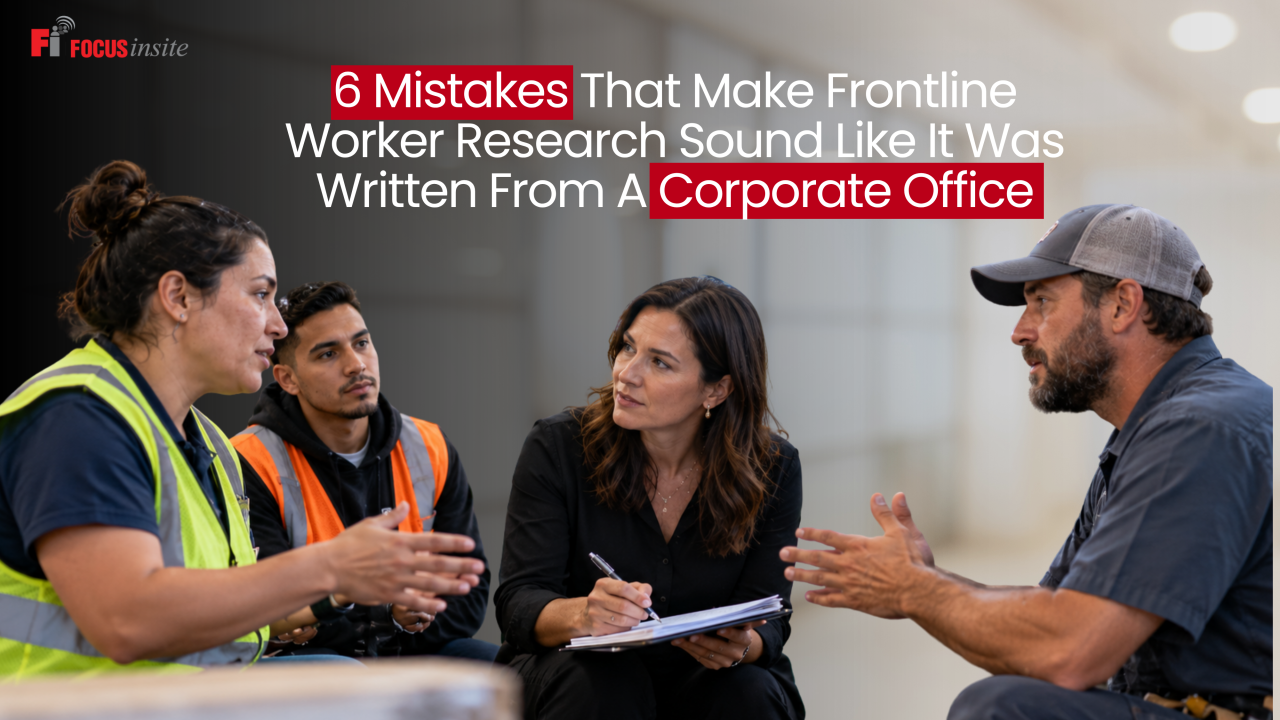
Frontline and deskless employee research has a sneaky failure mode: teams can do almost everything right and still learn from the wrong slice of reality. Enterprise insights, HR, product, and operations teams studying front line workers usually do not need more opinions; they need the right people with the right context at the right moment. That is why this article is intentionally different from the usual generic recruiting checklist. It focuses on the specific human realities inside this audience and what those realities mean for study design. The aim is simple: help research teams get closer to the people who can actually explain the behavior behind the business question.
So, in true listicle fashion, here are the 6 ideas that matter most for this specific kind of research. None of them require theater. They require a sharper definition of whose experience belongs in the room.
1. Recruiting supervisors instead of the people doing the work
Managers can describe policy. Frontline workers describe the shortcuts, interruptions, and physical reality of the job. The useful move is to ask for a recent example. Recent examples reveal sequence, stakes, and ownership in a way that broad self-description cannot. They also make it easier to distinguish true experience from secondhand familiarity. For Enterprise insights, HR, product, and operations teams studying frontline workers, that turns frontline worker research into a source of evidence rather than a collection of opinions. If a participant cannot describe the moment in concrete terms, the team should question whether that voice belongs in the study. A useful kickoff prompt is: what would this person have to have done recently for their answer to deserve weight in the decision?
2. Scheduling research during the worst possible shift
If participation requires someone to choose between a study and a busy shift, the sample will skew toward whoever can escape work. Do not let convenience choose this for you. The easiest people to recruit are often the most visible, responsive, or enthusiastic, which can create a subtle sample bias. Good deskless employee research deliberately includes the people who are harder to reach when those people represent the real market. That may require different sourcing channels, more thoughtful outreach, or a wider scheduling window, but the payoff is a sample that better reflects the decision environment. A useful sourcing check is to list the channels where this exact kind of person naturally works, learns, buys, or asks peers for advice, then recruit from more than one of them.
3. Using office language for non-office jobs
Terms like workflow optimization may sound normal in headquarters and absurd on a warehouse floor. Use language that matches the job. Think of this as a credibility checkpoint. If the final readout depends on this distinction, the recruiting plan should be able to explain how it was protected. That does not mean building a bureaucratic maze. It means using one or two clear questions, evidence checks, or sourcing rules that make the sample logic visible. The stronger the employee experience research, the easier it is for stakeholders to trust what the interviews are telling them. A useful quality check is to ask whether a skeptical stakeholder could understand why this participant belonged in the study without seeing the entire screener.
4. Ignoring device and connectivity reality
Many frontline workers use shared devices, rugged hardware, kiosks, or personal phones with limited access. Their technology context matters. This matters because frontline and deskless employee research is full of near-fit participants who sound relevant until the conversation gets specific. A strong recruiting plan turns the heading above into a qualification choice, not a nice-to-have. In practice, that means the team should document what evidence would make the participant credible and what evidence would make the same person a poor fit. The result is better frontline employee recruitment and fewer interviews that sound polished but do not move the decision forward. A useful kickoff prompt is: what would this person have to have done recently for their answer to deserve weight in the decision?
5. Forgetting power dynamics
Employees may worry that criticism gets back to managers. Trust, privacy, and neutral recruitment are essential for honest feedback. The trap is assuming the label tells you enough. In frontline and deskless employee research, labels hide variation in responsibility, recency, environment, and stakes. Ask what the person actually did, what changed because of their action, and what constraints they faced. Those details create stronger qualitative research recruitment because the respondent can speak from lived context instead of category familiarity. The best sample is not the one with the fanciest titles; it is the one that matches the business question. A useful sourcing check is to list the channels where this exact kind of person naturally works, learns, buys, or asks peers for advice, then recruit from more than one of them.
6. Confusing compliance with real behavior
The official process and the actual process can be two different worlds. Recruit for people who can explain what happens when the shift gets busy. Treat this as a design decision, not a scheduling detail. If the sample misses this dimension, the moderator may spend valuable time discovering the mismatch live. That is expensive and avoidable. Build the distinction into sourcing, qualification, and quota planning so the study captures the contrast on purpose. For Enterprise insights, HR, product, and operations teams studying frontline workers, this is one of the simplest ways to make workforce research more actionable without making the project more complicated than it needs to be. A useful quality check is to ask whether a skeptical stakeholder could understand why this participant belonged in the study without seeing the entire screener.
The Big Takeaway
The goal is not perfection. The goal is decision-quality. In frontline and deskless employee research, the best research teams know exactly whose experience should carry weight and why. That is what turns participant recruitment from a logistics task into a strategic part of the methodology. Before fieldwork starts, pressure-test the participant definition against the decision the research is supposed to support. If those two things are not tightly connected, fix the sample plan before the first interview rather than explaining the gap after the readout. For teams searching for better employee research participants, market research recruiting, participant recruitment, or operational research, the same principle applies: specificity beats convenience when the decision is high-stakes.
Need real, qualified people for your next high-stakes qualitative research study? Focus Insite recruits hard-to-reach professionals, customers, operators, decision-makers, and specialized audiences nationwide.
Business: Focus Insite Phone: 888-8-FOCUS-1 (1-888-836-2871)
Website: www.focusinsite.com
Email: [email protected]
Pressure-test your screener before your next study: assessment.focusinsite.com