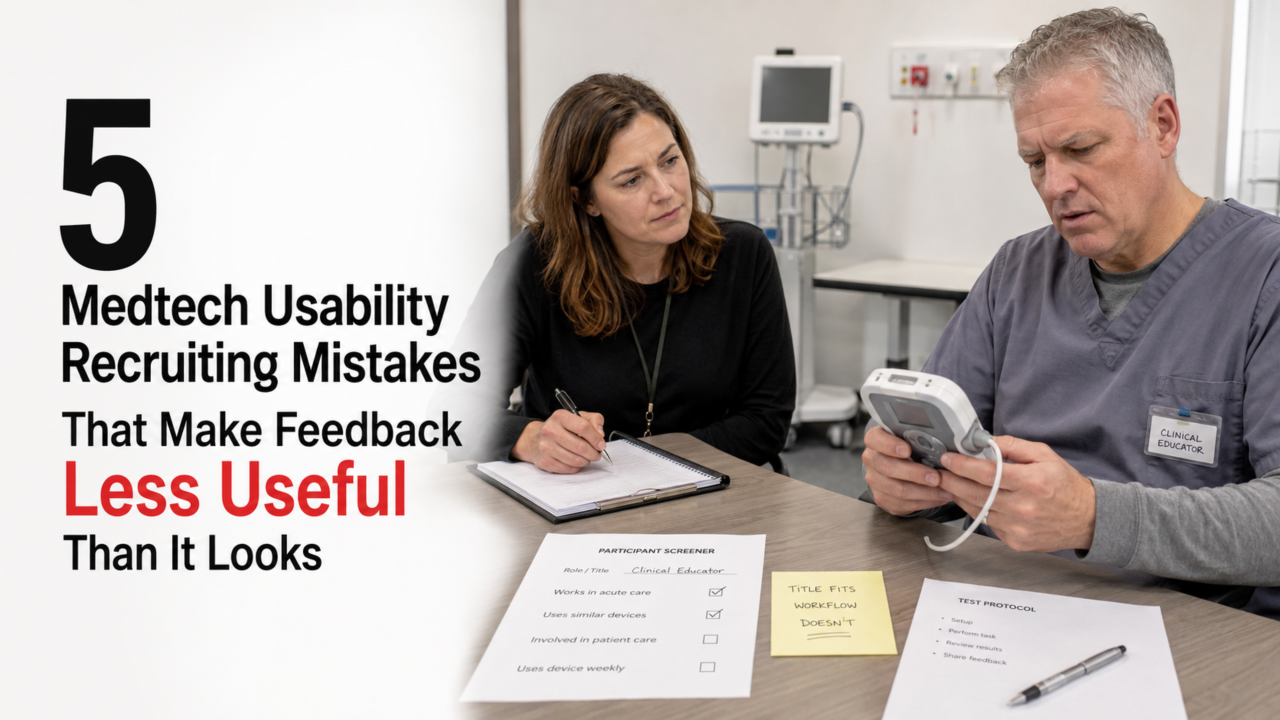
Medtech usability research is one of those areas where ‘close enough’ should immediately trigger side-eye. The right respondent may need specific clinical experience, patient interaction, device familiarity, workflow context, or care-setting knowledge. The wrong respondent can give feedback that sounds useful but misses the actual use environment.
Here is the not-so-glamorous truth: most research problems do not explode all at once. They creep in through tiny assumptions. The audience is a little too broad. The screener is a little too easy. The incentive is a little too tempting. The timeline is a little too tight. Then suddenly a multimillion-dollar decision is leaning on interviews that feel thinner than they should.
So, in true listicle fashion, let us unpack the top 5 mistakes to watch before your next study goes live. No panic. No finger-pointing. Just the stuff smart teams fix before the project gets messy.
One more thing before we get into the list: this is not about making research teams paranoid. It is about giving them language for the risk they already feel. Verification Vanessa, the Fortune 1000 insights leader, is not trying to make recruiting harder. She is trying to make the decision safer. She needs research participant screening, respondent verification, show-rate planning, and qualitative research recruitment to work together so the final insight can survive tough questions from product, marketing, UX, healthcare, finance, and leadership.
1. Recruiting by title only
A nurse, physician, technician, administrator, or patient may all touch a device differently.
Role alone does not prove use context.
Here is the quick gut check: if this mistake showed up in a stakeholder readout, would your team be comfortable explaining it? If the answer is no, fix it before fieldwork begins. The earlier you address it, the less expensive it becomes.
2. Ignoring care setting
Hospital, outpatient, home care, specialty clinic, and emergency environments create different realities.
Recruit for the environment the product lives in.
Here is the quick gut check: if this mistake showed up in a stakeholder readout, would your team be comfortable explaining it? If the answer is no, fix it before fieldwork begins. The earlier you address it, the less expensive it becomes.
3. Forgetting frequency of use
Someone who used a device once may not speak like someone who uses it weekly.
Frequency matters for usability insight.
Here is the quick gut check: if this mistake showed up in a stakeholder readout, would your team be comfortable explaining it? If the answer is no, fix it before fieldwork begins. The earlier you address it, the less expensive it becomes.
4. Under-screening for workflow involvement
Usability is not abstract. It lives inside steps, constraints, interruptions, and responsibilities.
Screen for the real workflow.
Here is the quick gut check: if this mistake showed up in a stakeholder readout, would your team be comfortable explaining it? If the answer is no, fix it before fieldwork begins. The earlier you address it, the less expensive it becomes.
5. Treating sensitive research like normal consumer feedback
Medtech research often touches safety, care, trust, compliance, and patient outcomes.
The recruit needs the right human layer from the start.
Here is the quick gut check: if this mistake showed up in a stakeholder readout, would your team be comfortable explaining it? If the answer is no, fix it before fieldwork begins. The earlier you address it, the less expensive it becomes.
For medtech usability recruitment, the difference between ordinary recruiting and strong recruiting is usually not one dramatic move. It is a stack of small, disciplined choices: define the audience clearly, source where the real people actually are, screen for lived experience, confirm attendance, watch for fraud signals, and communicate risk early. That is not overkill. That is how serious research earns trust.
A useful team exercise is to take your next recruit and ask three plain-English questions before anyone writes a screener: Who must this person really be? What would make them the wrong person even if they technically qualify? And how will we prove the difference before they get into the session? Those questions sound simple, but they reveal where most respondent quality risk is hiding.
This is also where procurement, ResearchOps, moderators, product leaders, and insights teams need to be aligned. If one group is optimizing for speed, another is optimizing for cost, and another is depending on the findings to make a major decision, the recruiting plan has to balance all three. Cheap sample that creates rework is not cheap. Fast recruiting that produces weak interviews is not fast. A full schedule that falls apart on interview day is not a win.
The big takeaway is simple: the quality of the insight cannot outrun the quality of the humans behind it. Better research is not only about better questions or better analysis. It starts earlier, with better recruiting decisions, clearer qualification, stronger respondent verification, and a partner who understands when a recruit needs more than generic sample.
For Fortune 1000 teams, this is where the conversation gets very practical. If the study supports a product roadmap, healthcare decision, AI validation, cybersecurity strategy, customer experience initiative, or go-to-market move, the sample needs to be more than full. It needs to be credible. It needs to be explainable. It needs to be defensible when leadership asks the obvious question: ‘How do we know these were the right people?’
Need real, qualified people for your next high-stakes qualitative research study? Focus Insite recruits and verifies participants across B2B, healthcare, patients, caregivers, executives, professionals, consumers, and hard-to-reach audiences.